
Reduce Light Pollution

Category

Activism & Education

Impact

Cost

?

Unnatural outdoor light at night both wastes energy and is unhealthy for humans and the environment. It can wreak havoc with the circadian rhythms of people and animals, seriously impacting health and disrupting the ecosystem.

Light pollution has a significant impact on wildlife. Nighttime light can disrupt the migration of many birds. Most songbirds migrate at night. Excessive nighttime light can disorient them, altering their path and even causing an increase in building collisions. 

Light pollution also has a serious aesthetic impact. There was a day when you could look at the night sky and see it lit up with stars with the bright streak of the Milky Way across the sky. Now only the brightest stars are barely visible. There was a day when kids could go down to the local school yard at night and collect a jar of fireflies in a few minutes. Now, with the impact of light pollution and pesticide use, a firefly is a rare sighting.

A few simple choices can greatly lessen the impact of outdoor lighting. 

Steps to Take

Turn off all outside lights that aren’t essential.

Where outdoor lights are essential, add motion detectors or timers so they are on the minimum amount of time.

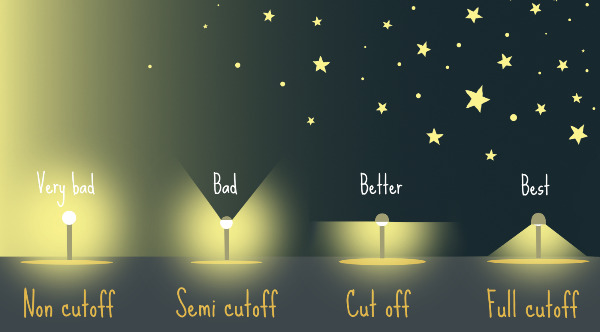
Choose outdoor fixtures that angle the light down and minimize light that is angled sideways or up.

Never choose daylight (4000K-6000K) light bulbs. Use yellow LED bulbs or warm white (2300K-2700K) bulbs.

Deep Dive

Obviously turning off any electric-powered device will reduce any energy consumption. What is less obvious is the impact of unnatural night-time light on both humans and the environment.

Nighttime light, especially blue light, can upset the natural day/night cycle of both people and animals. When exposed to light in the evening and at night, it can be harder to fall asleep and also cause a decrease in the quality of sleep. Additional health impacts may include worsened metabolism, weight gain, cardiovascular problems, mood, and mental health problems.  

https://www.darksky.org/light-pollution/human-health/

https://www.health.harvard.edu/staying-healthy/blue-light-has-a-dark-side 

https://time.com/5033099/light-pollution-health/

Light pollution is a significant but overlooked driver of the rapid decline of insect populations. Nighttime lights can lure moths to their death around light bulbs, disrupt the signals of fireflies, and make it easier for predators to prey on insects. And the insects affected are an important part of the ecosystem. Moths are important pollinators. There are many nighttime-blooming plants that are pollinated not by the bees and butterflies with which we are most familiar but by nocturnal moths.

https://www.darksky.org/light-pollution/wildlife/

https://www.ncbi.nlm.nih.gov/pmc/articles/PMC2627884/

Testimonials

🫠 No testimonials yet. Be the first to share your thoughts!

Add a Testimonial

0%

Subscribe

* indicates required
Email Preferences
Topic Areas of Interest