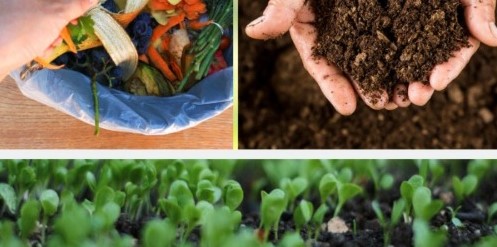
Why is composting important?
Over 51% of the trash that goes to landfills is compostable, including 60 millions tons of food per year. By composting, you prevent your food waste and other compostables from ending up in the landfill.
Why is it bad for compostable materials to end up in the landfill?
When any organic material breaks down, it will produce methane gas, a greenhouse gas with a warming potential roughly 21 times that of carbon dioxide. When organic waste such as food waste ends up in a landfill, the conditions there do nothing to mitigate the amount of methane produced as it breaks down, and all of its potential to be reused as fertilizer is lost. Meanwhile, most composting methods significantly reduce the amount of methane produced as organic materials break down. Then at the end of the process, compost can be reused as a natural fertilizer, reintroducing all the nutrients back into the soil that would have otherwise been wasted in a landfill.
Other compostable materials such as “compostable” plastics, need to break down under specific conditions and at specific temperatures that are only reached in industrial composting facilities. So if you’ve ever thrown a “compostable” cup, spoon, or straw into the trash, it didn’t really get composted. You can’t compost these at home, but Black Earth Compost does accept some of these compostable products. Look at the end of the first page of this helpful list to see what they can and can’t take.
What can I compost at home vs. with a service, and why is it different?
A commercial composting facility uses special tools and techniques to reach the perfect conditions to break down materials that are more difficult to compost, so not everything they accept will necessarily break down in your backyard pile. Additionally, some things simply take much longer to break down or will attract animals, and so aren’t recommended to put in a backyard pile, even if you could compost them eventually. In an industrial facility, these concerns are not a problem.
At home, you can compost leaves, garden waste, and food scraps that do not include meat, dairy, bones, corn cobs, and avocado pits. Egg shells can be hard to break down, and starchy foods can attract unwanted critters, so sometimes these items are a concern too. Meanwhile, in a commercial composting facility, all food waste is compostable as well as things like paper goods, pizza boxes, wood, fireplace ash, cooking oil, and grease. Click here to see the full list of what Black Earth Compost accepts.
What are Black Earth compostable bags made out of? Do they cause problems with microplastics?
The compostable liner bags for Black Earth are made of polylactic acid (PLA). PLA breaks down into carbon dioxide and water with the right temperature and moisture content. The right conditions are only found in commercial composting facilities that have high volumes of material, high heat, and high moisture content. PLA liners that are BPI-certified break down completely and do not contribute to the microplastics crisis.