Do not spray insecticide for mosquitoes across a broad area of your property. Do not hire commercial services that spray insecticides over a broad area of your property.
Beware of commercial sprayers that claim they are safe for pollinators as they avoid spraying the plants in bloom. Many beneficial insects such as butterfly caterpillars are present on plants when there are only green leaves and no flowers.
Be wary of any yard treatments labeled as natural or organic. There are natural insecticides that still can kill any insect. Even non-chemical formulae such as those based on essential oils can still kill soft-bodied insects such as butterfly caterpillars on contact and they are not very effective against mosquitoes.
If you want to use a spray that contains an aroma that repels mosquitoes, such as ones based on garlic, spray around the edges of your deck or patio, not on vegetation.
Watch this short video by D. Tallamy, Chair of Department of Entomology, University of Delaware which mentions building larva traps — https://www.youtube.com/watch?v=TqcDZDNtP-0
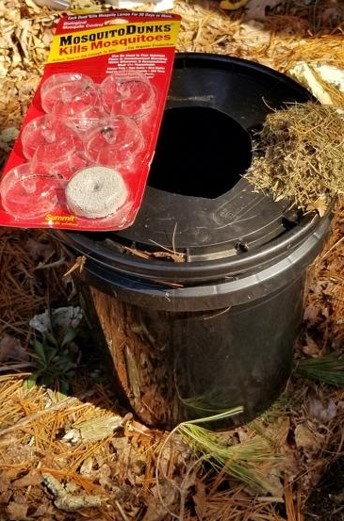
If you have the resources, try building one or two larva traps. All you need are one or two 5 gallon buckets, one pack of mosquito dunks, and a handful of vegetation matter that hasn’t been treated with chemicals such as leaves, grass, etc. Here’s an article with instructions — https://sidewalknature.com/2022/05/08/mosquito-bucket-of-doom/
Eliminate standing water on your property. Mosquitoes breed in stagnant water. A good example of how effective this technique is Walt Disney World in Florida. Despite being in an area where it could be rife with mosquitoes, there are virtually none without spraying any insecticide. The entire area has been designed so all water drains and there is no standing water.
Get a fan or two for your deck and/or patio. Mosquitoes are weak fliers and moving air flusters them.
Wear a personal repellent. DEET has been around for decades and works. Some don’t like DEET because of the aroma, oiliness, stinging, etc. and it can attack certain plastics. An effective alternative is repellents based on Picaridin which are widely available.
Grow native plants that will attract birds and predatory insects that eat mosquitoes.
One final step is to file the state of Massachusetts exclusion form for mosquito spraying — https://www.mass.gov/forms/request-for-exclusion-from-wide-area-application-of-pesticides. A request must be filed each year.